
How to Choose Chromium Carbide Overlay Plate?

Choosing the right Chromium Carbide Overlay Plate is rarely a simple catalog decision. The correct choice depends on wear type, impact energy, temperature, material flow, and maintenance limits. A plate that performs well in a cement chute may fail quickly inside a mining hopper. The service conditions decide the answer.

Tribology authority Kenneth C. Ludema described wear as “the progressive loss of substance from the operating surface.” This principle remains practical for engineers selecting overlay protection. A reliable evaluation should examine chromium carbide chemistry, weld deposit hardness, crack patterns, base-plate toughness, and actual plate thickness. Ask for test reports, production records, and traceable material certificates. Do not rely on hardness alone. High hardness can resist abrasion, but excessive brittleness may cause edge damage under repeated impact.

Look closely at the application. Is the material sliding, striking, or trapping between surfaces? Measure the chute angle, particle size, operating temperature, and replacement history. Photographs of worn liners can reveal more than a general equipment description. A dusty conveyor transfer point needs a different solution from a high-impact crusher discharge. Sometimes, the strongest plate is not the best plate.

This decision also requires honest reflection. Laboratory results may not represent field conditions. Welding quality, installation gaps, and unsupported areas can change service life dramatically. A competent supplier should explain limitations, not promise impossible performance. The most dependable selection combines field experience, metallurgical evidence, and a clear understanding of failure risks. Start with the wear mechanism, then compare plate grades against the real operating environment. That approach is slower, but usually more economical.
How to Choose Chromium Carbide Overlay Plate?

Understanding Chromium Carbide Overlay Plate Composition and Function

How to Choose Chromium Carbide Overlay Plate?

Chromium carbide overlay plate usually combines a mild-steel backing with a welded Fe-Cr-C wear layer. The backing provides structural support, while chromium-rich carbides resist abrasion. Typical overlays contain about 20–40% chromium and 3–7% carbon. Hardness often reaches 55–65 HRC, but hardness alone can mislead.

Particle size, impact force, temperature, and plate thickness change real performance. A fine carbide structure may resist sliding wear, while larger carbides can perform better against coarse minerals. The USGS Mineral Commodity Summaries 2025 identifies chromium as a key metallurgical material, especially in steel production. Meanwhile, World Steel Association data recorded approximately 1.89 billion tonnes of crude steel production in 2023. These figures reflect the demanding scale of mining, steel, and bulk-material handling equipment.

Check the working condition, not just the certificate. ASTM G65 testing can compare abrasive wear, but laboratory results may not reproduce wet ore, sharp impact, or thermal cycling. In practice, an extremely hard overlay can crack under heavy impact. That is an easy detail to miss. Plate selection should consider carbide distribution, weld quality, backing thickness, and repair requirements. Specifications should also reference ISO 14700 for hardfacing consumables where applicable.

Tips: Ask for chemical analysis, hardness mapping, thickness tolerance, and an ASTM G65 result. Inspect the cut edge for delamination. Review failed plates honestly; the wear pattern often explains more than a product brochure.

Assessing Wear Conditions and Application Requirements

How to Choose Chromium Carbide Overlay Plate?

Assessing Wear Conditions and Application Requirements

Choosing chromium carbide overlay plate starts with observing the wear, not guessing from hardness. Abrasion from dry rock differs from impact caused by large, falling chunks. Sliding coal can polish a surface, while wet slurry may accelerate erosion and corrosion together. Record particle size, moisture, temperature, impact angle, and operating hours. Small details matter.

The World Steel Association reported 1.89 billion tonnes of crude steel production in 2023. That scale reflects the constant demand placed on chutes, hoppers, screens, and transfer points. However, steel production data does not predict plate life. It only shows the industrial environment where wear control remains significant.

The USGS Mineral Commodity Summaries 2024 reported approximately 41 million tonnes of chromite mine production in 2023. Chromium availability supports alloy production, but chemistry alone cannot guarantee service performance.

Compare the plate’s overlay chemistry, crack pattern, thickness, and welding procedure with the measured duty. ASTM G65 testing can rank abrasion resistance under controlled conditions, but it cannot reproduce every field impact. A very hard layer may fail prematurely when the substrate flexes. I have seen specifications focus on hardness while ignoring support spacing and impact energy. That is an expensive blind spot. Leave room for uncertainty. Review worn samples after several weeks, measure actual thickness loss, and adjust the selection before permanent installation.

Comparing Plate Thickness, Hardness, and Overlay Properties

How to Choose Chromium Carbide Overlay Plate?

Comparing Plate Thickness, Hardness, and Overlay Properties

Selecting a chromium carbide overlay plate starts with the material’s working conditions. Abrasion, impact, heat, and sliding wear require different priorities. A thick plate is not always the strongest choice. It can add weight, complicate welding, and reduce equipment capacity. Measure the original wall thickness and expected wear depth before choosing the final size. A recurring lesson from field inspections is simple: nominal thickness can hide uneven wear. Check several points, not just one.

Hardness alone misleads. Many overlay plates fall near 55–65 HRC, but hardness testing methods can differ. The carbide structure, matrix composition, and distribution often control service life more than one hardness number. Coarse carbides may resist severe sliding abrasion, while finer structures can handle changing loads more evenly. Ask for test methods, overlay chemistry, and deposit uniformity. Request actual inspection records when possible. The paperwork matters.

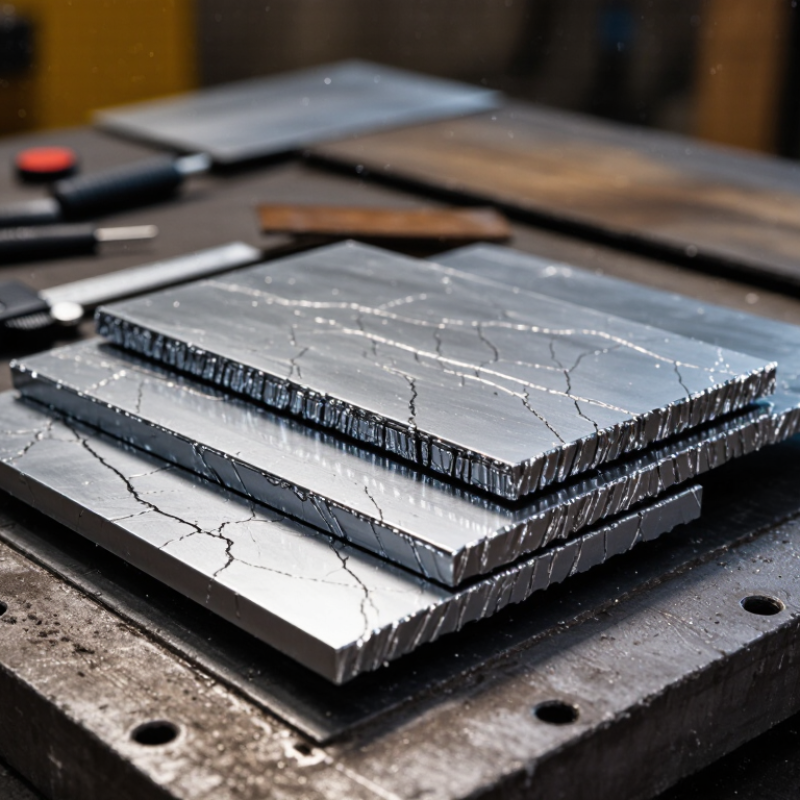
Overlay properties also include crack patterns, flatness, weldability, and heat resistance. Stress-relief cracks can appear naturally in the deposit, but wide, irregular cracks deserve investigation. I would inspect the surface before installation and avoid plates with unexpected separation or distortion. For impact-heavy chutes, excessive hardness may increase brittleness. That trade-off is easy to overlook. Field conditions often differ from laboratory tests, so review feed size, temperature, impact angle, and maintenance access before approving the plate.

Selecting the Suitable Substrate and Fabrication Method

How to Choose Chromium Carbide Overlay Plate?

Selecting the Suitable Substrate and Fabrication Method

The substrate supports the plate and absorbs impact, vibration, and welding stress. Choose its grade according to the equipment’s load, temperature, and installation conditions. Mild steel often suits general chutes, hoppers, and liners. Higher-strength steel may perform better under heavy impact, but it can require stricter preheating and welding control. Thickness also matters. A thin backing plate may reduce weight, yet it can distort during fabrication or service.

The overlay should match the wear mechanism, not only the advertised hardness. Abrasion from dry sand differs from impact caused by large, falling rocks. Overlay welding usually provides a practical balance between hardness and repairability. However, excessive heat can create distortion, cracks, or weakened areas near the weld. Fabricators should control heat input, inspect the surface, and confirm overlay thickness across the plate. Cutting and forming methods must be selected before production. Plasma or water-jet cutting may protect accuracy better than uncontrolled flame cutting. Bending is possible in some designs, but the minimum radius needs verification.

Tips: Check the substrate weldability before ordering. Ask for chemical composition, hardness data, overlay thickness, and test records. Inspect visible cracks and uneven deposits. Small variations matter. In practice, no selection is perfect. A plate optimized for abrasion may disappoint under severe impact, so actual service conditions deserve careful review.

How to Choose Chromium Carbide Overlay Plate? - Selecting the Suitable Substrate and Fabrication Method
Practical comparison of backing substrates, overlay fabrication methods, and selection criteria
Selection Dimension Option Suitable Conditions Key Advantages Important Limitations Recommended Decision
Substrate Material Carbon steel backing plate General abrasion applications such as chutes, hoppers, liners, wear bins, and conveyor components Good weldability, broad availability, relatively low cost, and easy cutting or forming before overlaying The backing plate is not intended to provide corrosion resistance; excessive heat can cause distortion Choose this as the default substrate when structural strength and wear resistance are more important than corrosion resistance
Substrate Material Low-alloy or HSLA steel backing plate Applications requiring higher structural strength, reduced backing thickness, or improved load-bearing capacity Higher yield strength than ordinary mild steel can help reduce weight in structural components Welding becomes more procedure-sensitive; preheating, interpass temperature, and hydrogen control may be required Use only after checking carbon equivalent, weldability, required preheat, and the qualified welding procedure
Substrate Material Austenitic stainless steel backing plate Equipment that needs corrosion resistance from the backing material in addition to abrasion protection Better resistance to many wet or chemically active environments than carbon steel Higher material cost, greater thermal expansion, and more complex welding and dilution control Select only when the service environment justifies stainless backing; verify compatibility of filler metal and overlay procedure
Fabrication Method Open-arc flux-cored arc welding Custom plate dimensions, irregular components, field repairs, and applications needing flexible bead placement Flexible operation, suitable for many positions, and capable of depositing chromium-carbide-rich wear layers Fume generation, spatter, dilution, and heat input must be controlled; surface checking can occur as part of stress relief Choose for versatility and repairability, especially when the component geometry is not suited to automated welding
Fabrication Method Submerged arc welding Large, flat, or regularly shaped plates manufactured in a controlled workshop environment High deposition rate, stable arc conditions, consistent bead geometry, and reduced visible arc radiation Usually requires suitable welding position and equipment; high heat input can increase distortion and dilution Prefer for repeat production, large plate areas, and applications where uniformity and productivity are priorities
Fabrication Method Tandem or multi-wire submerged arc welding High-volume production of wide or thick overlay plates Very high productivity and efficient coverage of broad surfaces Requires precise process control; accumulated heat may increase residual stress, distortion, and carbide dilution Use when production scale is high and the manufacturer can demonstrate control of hardness, thickness, and flatness
Fabrication Method Manual shielded metal arc welding Small repairs, localized wear areas, and maintenance work where automated equipment is unavailable Portable equipment, low setup cost, and access to difficult locations Lower productivity and greater dependence on operator skill; bead consistency may be less uniform Select for repair work rather than large-scale plate production
Alternative Coating Process Thermal spray, such as HVOF Thin coatings, low heat input requirements, and applications where dimensional control is more important than a thick weld overlay Low substrate heat input and the ability to apply dense carbide-based coatings to selected surfaces Generally not a direct replacement for thick chromium carbide overlay plate in severe impact or heavy-section wear service Choose only when the required coating thickness, impact level, adhesion, and service temperature are compatible with thermal spraying
Wear Mechanism Sliding or gouging abrasion Material flow involving sand, coal, minerals, clinker, cement, or similar hard particles Hard chromium-rich carbides embedded in a metallic matrix provide strong resistance to mineral abrasion Very hard overlays can be less suitable where severe impact, bending, or forming is dominant Prioritize carbide content, overlay hardness, thickness, and backing support for abrasive service
Impact Requirement High impact or repeated shock Large rocks, drop zones, impact crushers, and equipment exposed to dynamic loading A tougher overlay matrix and stronger backing support can reduce premature spalling or cracking Maximum hardness is not always the best choice; an excessively brittle overlay may crack or chip under impact Select a balanced hardness-toughness design and consider a tougher wear plate if impact dominates abrasion
Overlay Thickness Approximately 3–20 mm wear layer Thickness selection depends on wear rate, replacement interval, component clearance, and allowable weight Thicker overlays generally provide more wear allowance before replacement Extra thickness increases weight, heat input, cost, and potential distortion; actual available ranges vary by process Specify both backing thickness and overlay thickness separately, then verify dimensional tolerances after welding
Hardness and Microstructure Chromium-carbide-rich overlay Severe mineral abrasion where a hard carbide phase is needed Typical deposits may show an overlay hardness around 55–65 HRC, with chromium carbides distributed in a metallic matrix Hardness values, carbide morphology, carbide volume fraction, and crack patterns vary with chemistry and welding parameters Require test results using a defined hardness method and acceptance criteria; do not select by hardness alone
Forming and Machining Flat plate, formed plate, or cut component Projects requiring rolling, cutting, countersinking, drilling, or attachment by welding Carbon steel backing can usually be cut and welded with suitable procedures before or after overlaying The overlay is difficult to machine conventionally; carbide-tipped tools, abrasive cutting, or specialized processes may be required Complete forming and most drilling or cutting operations before overlaying whenever the design permits
Quality Verification Inspection and acceptance requirements All industrial applications where service life, safety, and interchangeability are important Documented checks improve consistency of thickness, hardness, flatness, surface condition, and weld integrity Visual inspection alone cannot confirm all performance-related properties Request material certificates, dimensional inspection, hardness testing, visual examination, and additional non-destructive testing when required
Note: The thickness, hardness, carbide structure, allowable forming radius, and welding parameters shown above are typical engineering ranges or guidelines. Final selection should be based on the actual abrasive material, impact level, operating temperature, corrosive environment, component geometry, and qualified fabrication procedure.

Checking Quality Standards, Compatibility, and Service Life

How to Choose Chromium Carbide Overlay Plate?

Checking Quality Standards, Compatibility, and Service Life

A reliable chromium carbide overlay plate should have traceable test records. Check chemical composition, overlay hardness, thickness, and dimensional tolerances. Recognized material standards can support consistency, but certificates alone are not enough. Ask whether an independent laboratory verified the results. Inspect the surface for cracks, uneven beads, exposed base metal, and excessive distortion. Small defects may become larger under repeated impact.

Compatibility depends on the working environment. Identify whether the equipment handles sliding abrasion, heavy impact, or both. A chute carrying sharp limestone needs different protection from a pipe transporting fine ash. Check the base metal, welding method, plate curvature, operating temperature, and available clearance.

The plate should fit without forcing bolts or creating unsupported edges. Installation quality matters greatly.

Service life should be estimated from actual wear conditions, not hardness alone. Compare plate thickness with expected abrasion rates, impact frequency, and daily operating hours. In practical inspections, a thicker plate may last longer, but it can increase weight and structural stress. That trade-off is easy to overlook. Keep records of installation dates, worn areas, and replacement intervals. These details improve future selection.

A useful choice is measurable, compatible, and maintainable. Yet predictions remain imperfect. Real materials vary. Weather, loading changes, and poor alignment can shorten service life. Review the evidence before accepting a confident promise.