Top Vintage Shoe Cabinet Manufacturers for Global Buyers
A Vintage Shoe Cabinet must do more than hide scattered footwear. It needs to fit a narrow entryway, protect shoes from dust, and open smoothly after years of daily use. For global buyers, choosing a manufacturer also means weighing material quality, finish consistency, production capacity, packaging, and communication.
Grand View Research valued the global home furniture market at USD 229.3 billion in 2023 and projected a 5.4% compound annual growth rate from 2024 to 2030. Its report covers broad furniture categories, not vintage-style shoe cabinets specifically. That distinction matters: broad market growth cannot confirm demand for any individual design. UN DESA’s World Urbanization Prospects 2018 also projected that 68% of the global population would live in urban areas by 2050, underscoring the relevance of space-conscious home furnishings. These figures offer context, not a guarantee of sales.
Details matter. A buyer should check cabinet dimensions, board or solid-wood specifications, hinge performance, ventilation, surface treatment, and carton protection. Ask for recent production photos and clear test or inspection records. A polished catalog is not enough. A photograph can hide a loose hinge or uneven finish, and even a capable supplier may need clearer specifications from the buyer. The manufacturers compared here should therefore be assessed on verifiable product information, customization options, quality controls, and export experience—not appearance alone.
Understanding Vintage Shoe Cabinets and Their Global Market
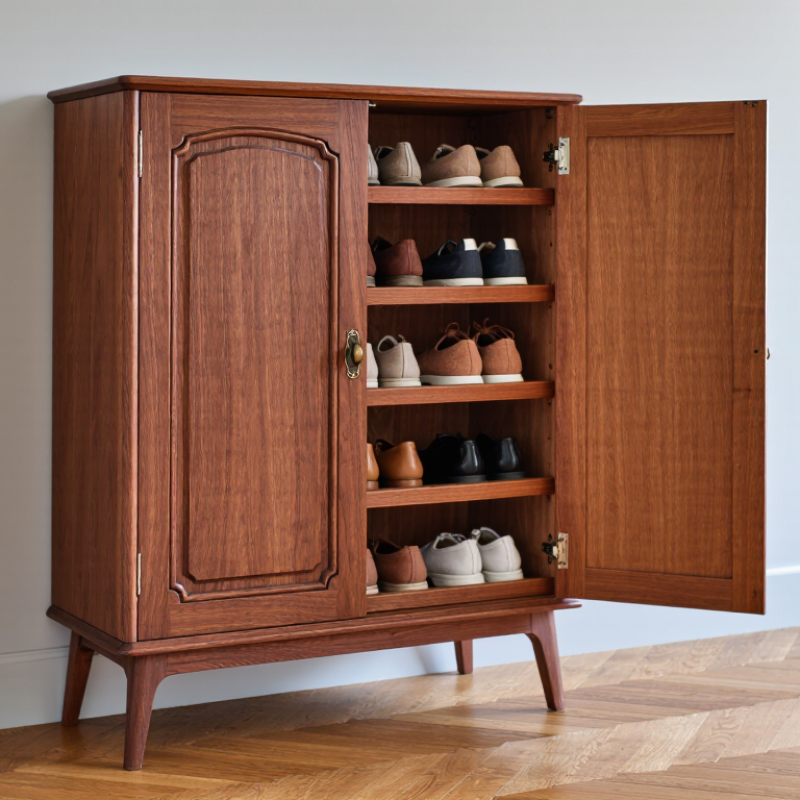
Vintage shoe cabinets combine compact storage with period character, often through framed doors, tapered legs, patinated finishes, and visible wood grain. Buyers should distinguish genuine age from a newly made cabinet with a vintage-inspired look. Ask manufacturers for material specifications, finish samples, internal shelf dimensions, and close-up photographs of joints and hardware. A cabinet that looks spacious may not fit modern sneakers or taller boots.
The wider furniture market offers useful context, but not a direct measure of this niche. Grand View Research valued the global furniture market at USD 736.2 billion in 2023 and forecast a 5.9% compound annual growth rate from 2024 to 2030 in its Furniture Market Size, Share & Trends Analysis Report. That is not a vintage shoe cabinet forecast. UN Comtrade classifies furniture trade within broader product categories, making this specific style difficult to track separately. There is a catch.
For global sourcing, compare usable capacity, wood or engineered-board content, hardware, finish consistency, and export packaging. Request carton dimensions and protective-packaging details; projecting legs and glass panels need careful handling. Check whether measurements use millimetres or inches, and confirm the stated finish under natural light. Small details matter. A point worth questioning: “vintage” describes appearance, not necessarily age, provenance, or construction quality.
Vintage Styles, Materials, and Construction Features
Vintage-inspired shoe cabinets often combine familiar silhouettes with storage suited to modern homes. Buyers may find Shaker-style doors, turned legs, or gently curved fronts. These details give a cabinet character without making it difficult to pair with newer furniture. Small details matter. Check that doors open fully when the cabinet sits beside a wall or hallway bench.
Materials shape both appearance and performance. Solid wood offers a tactile grain, while wood veneer over engineered panels can create a consistent look at a lower weight. Rattan inserts add texture and allow some airflow, though they may collect dust between the weave. Metal pulls and hinges should feel secure, not merely decorative. A distressed finish can soften visible scratches, but it may also look uneven in bright light.
Construction deserves close inspection. Adjustable shelves help accommodate boots and low-profile shoes, while ventilation slots can reduce trapped odors. Ask about panel thickness, hinge quality, and how the cabinet is packed for long-distance shipping. A stable base matters on tiled floors, where narrow legs can wobble. Finish samples are useful, but they never show every variation in natural wood; that uncertainty is worth discussing before ordering.
Types of Manufacturers and Regional Production Hubs
Vintage shoe cabinet manufacturers usually fall into three groups: solid-wood furniture specialists, reclaimed-wood workshops, and larger OEM factories producing mixed-material designs. Solid-wood makers can offer carved fronts, turned legs, and hand-applied finishes, but lead times may vary. Reclaimed-wood workshops create distinctive grain and patina. Ask how they control moisture and check boards for cracks before assembly. Larger factories can handle repeat orders and custom dimensions, though “vintage” may mean a surface finish rather than aged materials. The boundary is not always clear.
Regional production hubs offer different strengths. China has broad furniture supply chains and options for scaled production. Vietnam and Indonesia have established woodworking sectors, with capabilities that differ by factory and material. European workshops may suit buyers seeking smaller runs or detailed finishing, but costs and capacity vary. These are starting points, not guarantees. Request recent production photos, a sample cabinet, and written details on wood type, hardware, finish, packaging, and inspection standards.
Tips: Check the cabinet’s internal depth with an actual shoe, not just a catalog diagram. Confirm ventilation openings and shelf spacing. Ask for a finish sample under natural light; screen images can hide color shifts. Keep one detail flexible, but not the measurements.
How to Evaluate Manufacturers for Quality and Reliability
A polished catalog cannot prove that a vintage shoe cabinet will stay sturdy after years of daily use. Request a production sample and inspect its joints, back panel, drawer alignment, and finish under ordinary room lighting. Small gaps matter. Open and close each door repeatedly; listen for scraping and check whether hinges loosen. Ask what solid wood, veneer, or engineered panels are used, and where each material appears. The distinction affects weight, stability, and repair options. A moisture-resistant coating may help, but it cannot correct poorly dried timber. Buyers sometimes focus too heavily on appearance. That is an easy mistake.
Reliable manufacturers can explain how they control quality across repeat orders, not just one attractive sample. Ask for inspection criteria, acceptable size tolerances, packaging details, and records from recent production checks. Request clear photos of cabinet interiors and carton drop-test procedures, where available. Check whether shelves support the stated load without bowing, and whether corners remain protected during shipping. Communication is part of the assessment. Note how quickly questions receive specific answers, especially when discussing defects, replacement parts, or production delays. A factory visit or independent inspection can add confidence, though neither guarantees every unit will be perfect. Keep written specifications, and compare them with the sample before approving bulk production. Some details may still be missed; build time for one careful review.
Evaluating Vintage Shoe Cabinet Manufacturers: Quality Audit Priorities
Suggested allocation of supplier-audit effort across practical quality and reliability checks.
Use these planning weights to structure an evaluation—not as measured industry statistics. Prioritize material and dimensional checks, then verify stability, finish durability, and protective packaging with documented test records.